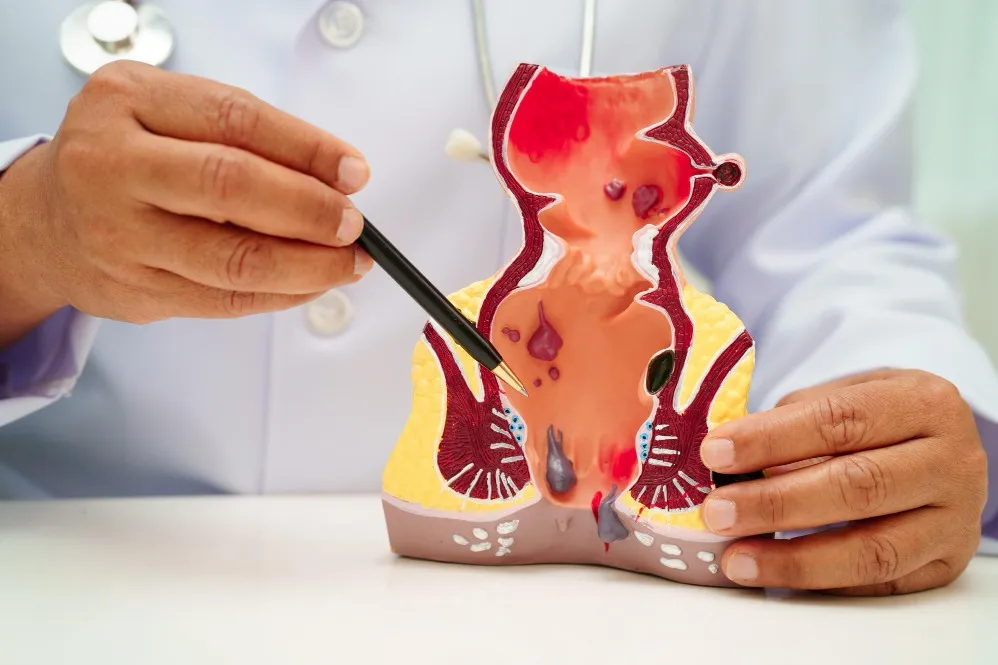
Internal haemorrhoids often cause bright red bleeding during bowel movements. Some patients also notice mucus, irritation, incomplete evacuation or tissue protruding from the anus. Because internal haemorrhoids can range from mild swelling to persistent prolapse, “advanced treatment” does not mean the same procedure for every patient.
Treatment should be matched to the grade of haemorrhoids, the dominant symptom and the patient’s previous response to care.
Understanding the Four Grades
Internal haemorrhoids are commonly described in four grades:
- Grade I: Enlarged tissue remains inside the anal canal.
- Grade II: Tissue protrudes during straining but returns by itself.
- Grade III: Prolapsed tissue must be pushed back manually.
- Grade IV: Tissue remains outside and cannot be reduced normally.
Grading is useful, but it is not the only consideration. Bleeding severity, external components, thrombosis, bowel habits and other medical conditions also influence treatment.
Treatment for Earlier-Grade Disease
Grade I and some Grade II haemorrhoids may improve with constipation management and an office-based procedure. Options can include rubber-band ligation, injection treatment or infrared-based therapy, depending on availability and suitability.
Rubber-band ligation places a small band around the base of selected internal haemorrhoidal tissue to interrupt its blood supply. It is intended for internal disease and is not simply applied to painful external piles.
Conservative care remains essential. Without addressing hard stools, prolonged toilet sitting and repeated straining, symptoms may return even after a successful procedure.
Options for Prolapsing Internal Haemorrhoids
For persistent Grade II, Grade III or selected Grade IV disease, a surgeon may discuss:
- Haemorrhoidal artery ligation
- Stapled haemorrhoidopexy
- Laser-assisted haemorrhoid procedures
- Conventional excisional haemorrhoidectomy
- Combined treatment for internal and external disease
Each option has a different balance of postoperative discomfort, recurrence risk and suitability for advanced prolapse. A technique associated with less early pain may not necessarily be appropriate for extensive external components or very large prolapsing piles.
Why Examination Matters
Bleeding during bowel movements is often associated with piles, but it can also result from an anal fissure, inflammation, polyps or bowel cancer. A surgeon may perform a visual examination, digital rectal examination or proctoscopic evaluation. Further bowel investigation may be recommended based on age, symptoms, family history or anaemia.
Patients should not repeatedly purchase piles medication without assessment when bleeding persists. Treatment aimed at the wrong diagnosis delays appropriate care.
Choosing Between Procedures
A useful consultation compares options in practical terms:
- What symptoms will the procedure address?
- Will external piles remain untreated?
- Is anaesthesia required?
- How much discomfort is expected?
- When can work and exercise resume?
- What is the possibility of recurrence?
- What complications require urgent review?
A surgeon should also explain whether the proposed laser technique removes tissue, shrinks it or closes its feeding vessels. The word “laser” by itself does not provide enough information for informed consent.
Local Surgical Evaluation
For patients in Navi Mumbai, Maharashtra, access to a surgeon who discusses sensitive symptoms without judgement can make evaluation easier. Dr Janhavi Kapadia offers assessment for internal haemorrhoids, including consultations for patients who prefer a female surgeon.
Prompt assessment is particularly important when bleeding is heavy, recurrent or accompanied by weakness, weight loss, black stools or altered bowel habits. Advanced treatment is most effective when it follows an accurate diagnosis, appropriate grading and a clear discussion of realistic outcomes.
Keywords