Repeated attacks of upper-abdominal pain deserve more than another course of painkillers, especially when the episodes follow meals or last for hours. By the end, you will know which symptoms need urgent hospital care, which tests clarify the cause, and when gallbladder removal is more appropriate than continued observation.
Key takeaways
- Biliary colic causes steady upper-right abdominal pain lasting 30 minutes to several hours.
- Ultrasound usually checks for gallstones; blood tests assess infection or bile-duct blockage.
- Seek urgent care for fever, jaundice, persistent vomiting or pain that does not settle.
- Recurring symptomatic gallstones often require assessment for laparoscopic gallbladder removal.
Does your pain fit biliary colic, or could it be something else?
Biliary colic usually causes steady pain in the right upper abdomen or upper middle abdomen, often after a fatty meal. It can spread to the right shoulder or back and last from 30 minutes to several hours.
Repeated attacks with the same pattern make gallstones more plausible, but a scan finding alone does not prove they caused the pain.
| Possible cause | Clues that make it different |
|---|---|
| Indigestion, gastritis or GERD | Burning discomfort, sour taste, belching or pain linked to lying down |
| Peptic ulcer disease | Gnawing upper-abdominal pain related to meals, sometimes with black stools |
| Pancreatitis | Severe, persistent upper-abdominal pain radiating to the back, with vomiting |
| Appendicitis | Pain that shifts toward the lower right abdomen with increasing tenderness |
| Liver or bile-duct disease | Pain with jaundice, dark urine, pale stools or abnormal liver tests |
Seek urgent hospital assessment for:
- Fever or chills
- Jaundice, dark urine or pale stools
- Severe or constant pain
- Persistent vomiting or inability to keep fluids down
- Confusion, fainting or marked abdominal tenderness
A clinician can compare your history and examination with an abdominal ultrasound, liver-function tests and a complete blood count. MRCP or CT may follow when a bile-duct stone or complication is suspected.
If attacks keep returning and match biliary colic, discuss laparoscopic gallbladder removal rather than relying on repeated painkillers; compare gallstone treatment options in Mumbai by diagnostic accuracy and emergency backup, not location alone.
Which tests confirm whether gallstones are causing the attacks?
An ultrasound finding is evidence of stones, not proof that stones caused the attack. Assessment begins with your pain history and abdominal examination. The clinician checks whether the pattern fits gallbladder pain and considers reflux, peptic ulcer disease, pancreatitis, liver disease and cardiac causes.
| Test | What it shows | What it cannot prove |
|---|---|---|
| Abdominal ultrasound | Gallstones, gallbladder-wall thickening, fluid, and bile-duct widening | That an incidental stone caused your pain |
| Liver-function tests | Bile-duct blockage or liver irritation through bilirubin, alkaline phosphatase and enzyme levels | The exact location of a stone |
| Complete blood count | Raised white cells suggesting inflammation or infection | Whether pain without inflammation is from a stone |
| MRCP or CT | Suspected common-bile-duct stones, pancreatitis or other complications | A need for surgery based on imaging alone |
Ultrasound is usually the first imaging test. Blood tests add context, while MRCP or CT helps when a duct stone or complication is suspected. Severe constant pain, fever, jaundice, repeated vomiting or confusion needs urgent hospital assessment.
A person with stones but no compatible symptoms usually does not need preventive gallbladder removal. Surgery becomes a clinical decision when attacks recur or complications develop; special high-risk findings can change that plan.
If you consult a gallstone doctor in Mumbai, ask how the pain, examination, ultrasound and blood results support the diagnosis, and when ERCP would be needed for a duct stone.
What can you do while deciding on definitive treatment?
A painkiller can settle an attack; it cannot stop the next stone from blocking the gallbladder outlet. While comparing gallstone treatment options in Mumbai, use temporary measures only after a clinician has assessed the pattern and prescribed medicines safely.
- Pain relief: Paracetamol or an anti-inflammatory medicine may reduce biliary-colic pain. Ask before using anti-inflammatories if you have a stomach ulcer, kidney disease, blood-thinning treatment or pregnancy.
- Dietary changes: Smaller, lower-fat meals can reduce attacks triggered by gallbladder contraction. Avoiding fried foods does not dissolve stones or remove the risk of another blockage.
- Antibiotics: These treat bacterial infection in conditions such as acute cholecystitis or cholangitis. They do not remove stones, and repeated antibiotic courses do not replace treatment that provides source control.
- Ursodeoxycholic acid: This bile-acid medicine can dissolve selected small cholesterol stones when the gallbladder still works. Treatment takes months or longer, applies to limited cases, and stones can return after it stops.
These measures have clear limits. Recurrent attacks usually need a discussion about laparoscopic gallbladder removal rather than repeated painkillers or stone dissolution. Seek urgent hospital care for fever, jaundice, dark urine, persistent vomiting, confusion, fainting or severe constant pain; antibiotics alone may be unsafe when a duct remains blocked.
When is laparoscopic gallbladder removal the appropriate option?
Recurrent attacks that fit biliary colic are a standard reason to discuss elective laparoscopic cholecystectomy, after confirming that gallstones explain the pain. Removing the gallbladder prevents new stones from causing further attacks; repeatedly using painkillers does not. Gallstones found by chance without symptoms usually do not justify surgery unless a separate high-risk finding exists.
Arrange prompt hospital assessment for fever, jaundice, dark urine, persistent vomiting, severe constant pain or confusion. Acute cholecystitis, cholangitis, gallstone pancreatitis or a blocked bile duct can require urgent treatment, followed by gallbladder removal when safe.
Ask what the operation plan includes:
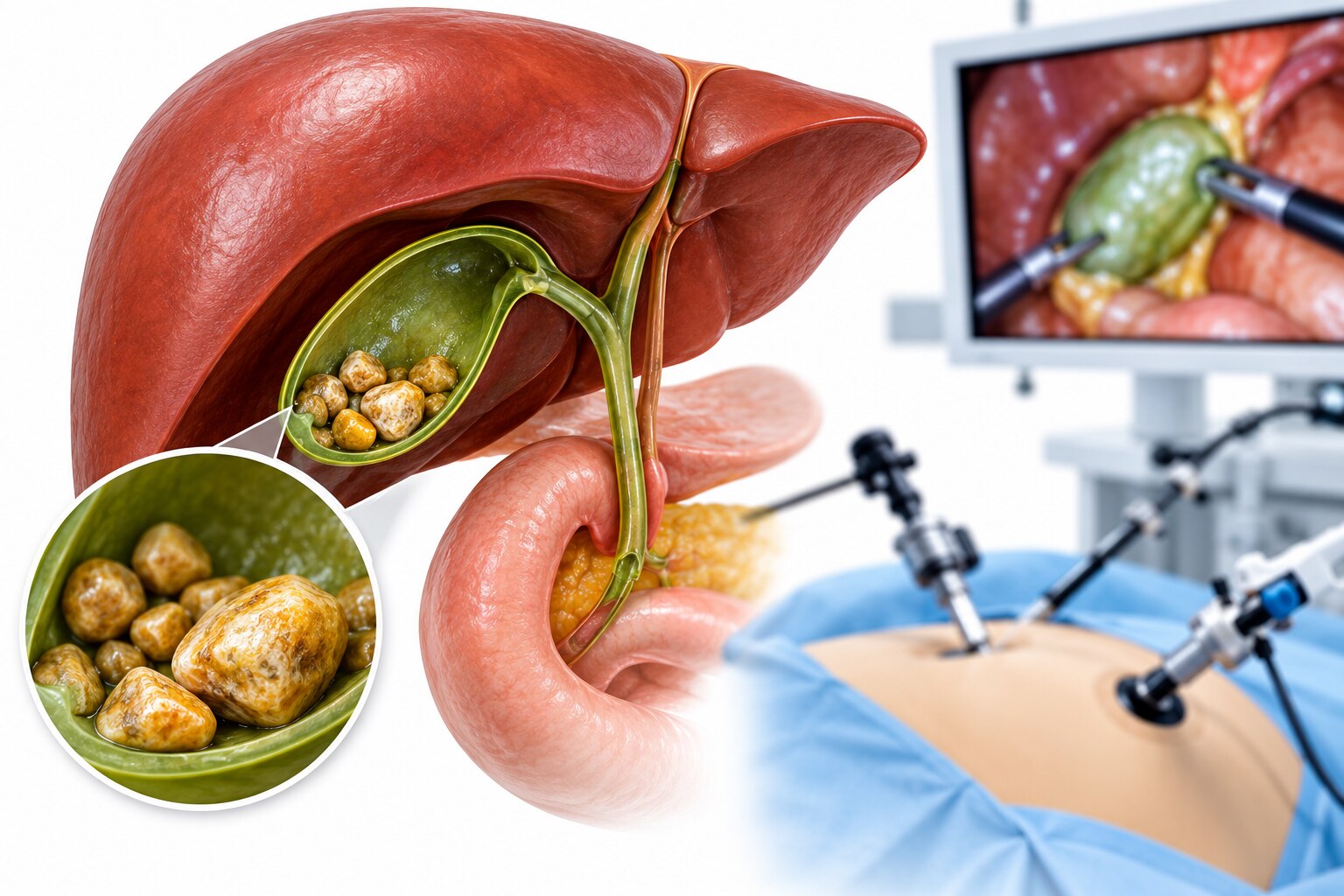
- Laparoscopic cholecystectomy under general anaesthesia, using several small abdominal incisions.
- Investigation for a common-bile-duct stone with liver tests and, when indicated, MRCP or endoscopic ultrasound.
- ERCP before or after surgery when a duct stone or obstruction needs treatment; it can cause pancreatitis, bleeding, infection or perforation.
- Open surgery if severe inflammation, scarring or an unexpected finding makes keyhole surgery unsafe.
| Option | What it does | Typical role |
|---|---|---|
| Laparoscopic cholecystectomy | Removes the gallbladder | Recurrent symptomatic stones |
| ERCP | Removes a retained duct stone | Duct obstruction or high stone probability |
| Open cholecystectomy | Removes the gallbladder through a larger incision | Unsafe or unsuccessful laparoscopic approach |
Many patients go home the same day or after one night. Expect incision soreness, temporary shoulder-tip discomfort and gradual return to normal activity; follow the surgeon’s restrictions on driving, lifting and wound care. Compare gallstone treatment options in Mumbai by checking surgical experience, ERCP access and postoperative backup, not location alone.
How should you choose gallstone care in Mumbai, including near Sion?
A clinic five minutes away is not automatically the safest choice. For gallstone surgery near Sion, weigh travel time against access to anaesthesia, imaging, ERCP and postoperative monitoring if the plan changes.
Ask the surgeon and hospital:
- Is the surgeon appropriately registered, and who will perform the operation?
- How often does the surgeon perform laparoscopic cholecystectomy?
- How will you investigate a suspected common-bile-duct stone: liver-function tests, ultrasound, MRCP or another test?
- If a duct stone is found, can the hospital provide urgent ERCP, and who will perform it?
- What findings would require ERCP, conversion to open surgery or overnight observation?
- Who handles complications, pain review and wound checks after discharge?
| Choice | Main advantage | Check before booking |
|---|---|---|
| Local clinic near Sion | Easier consultations and follow-up | It may not have 24-hour imaging, ERCP or admission beds |
| Hospital with surgical backup | Faster response when complications arise | Confirm anaesthesia, ERCP and postoperative monitoring |
| Distant specialist centre | Access to a particular surgeon | Plan transport, emergency access and follow-up visits |
Ask a gallstone doctor in Mumbai whether the hospital can manage pancreatitis, bleeding, infection or a retained duct stone; removing the gallbladder does not remove a duct stone. Dr Janhavi Kapadia can discuss both the operation and the backup needed for your individual risk.
Do not wait for a routine appointment with severe constant pain, fever, jaundice, repeated vomiting, confusion or fainting.
Related service
Gallstones Gallstones Gallstones are hardened deposits that form in the gallbladder, a small organ located under the liver that stores bile, a digestive fluid produced by... |
Frequently asked questions
How can you tell biliary colic from another cause of abdominal pain?
Biliary colic usually causes steady pain in the right upper or upper middle abdomen after a fatty meal. It can spread to the right shoulder or back and last 30 minutes to several hours. Similar pain can come from pancreatitis, peptic ulcer disease, reflux, liver conditions or heart problems, so examination is important.
Which tests confirm whether gallstones are causing repeated attacks?
An abdominal ultrasound usually looks for gallstones, gallbladder-wall thickening and bile-duct enlargement. A clinician may order a complete blood count, liver-function tests including bilirubin and an amylase or lipase test. MRCP, HIDA scanning or other imaging is used when ultrasound does not answer the question or a bile-duct stone is suspected.
What can you do while deciding on definitive gallstone treatment?
Choose smaller, lower-fat meals and avoid foods that repeatedly trigger pain. Do not self-treat severe or recurring pain without medical advice. Go to urgent care for fever, jaundice, persistent vomiting, dark urine, pale stools or pain that remains severe.
When is laparoscopic gallbladder removal appropriate?
Laparoscopic cholecystectomy is commonly considered when gallstones cause repeated biliary colic, acute cholecystitis, pancreatitis or complications from bile-duct stones. A surgeon reviews your symptoms, imaging, medical history and anaesthesia risks before recommending surgery.
How should you choose gallstone care in Mumbai, including near Sion?
Choose a gallstone doctor in Mumbai who can review ultrasound images and blood results, explain non-surgical and surgical choices, and provide a clear urgent-care plan. If you are comparing gallstone surgery near Sion, ask where the operation, anaesthesia, pathology review and follow-up will take place.
Keywords