A reflux surgery appointment is not an automatic step from symptoms to an operation. The surgeon first checks whether reflux explains your symptoms, reviews treatment response and test results, identifies warning signs, and then decides whether more testing or surgery is appropriate.
Key takeaways
- Bring your medicine list, endoscopy reports and previous scan results.
- Ask whether endoscopy, pH monitoring or manometry is needed before surgery.
- Surgery decisions depend on confirmed reflux, symptoms and response to treatment.
- Leave with a diagnosis, next steps, alternatives and warning signs to monitor.
What happens when you book and describe your symptoms?
The opening of a GERD surgery consultation in Mumbai is a symptom assessment, not an automatic step toward an operation. The surgeon asks what you feel, when it began, how often it occurs, whether it wakes you at night and whether treatment has changed it.
Describe each symptom plainly and give its frequency. Include:
- Burning behind the breastbone, sour fluid or food returning into your mouth, and upper-abdominal or chest discomfort.
- Cough, hoarseness, throat clearing or a bad taste, especially after meals or when lying down.
- Difficulty swallowing, food sticking, or pain when swallowing.
- Vomiting, night-time symptoms, reduced eating and any unintentional weight change.
- The names, doses and duration of acid-reducing medicines, plus what happened when you missed or stopped them.
The surgeon will compare this pattern with previous diagnoses, endoscopy findings and other possible causes. Heartburn and regurgitation support reflux more directly than cough or hoarseness; throat symptoms alone do not prove that reflux caused them. Persistent symptoms despite medication also do not automatically mean surgery is appropriate.
Mention alarm symptoms immediately: vomiting blood, black stools, progressive difficulty swallowing, painful swallowing, persistent vomiting, unexplained weight loss, anaemia or severe chest pain. These findings can require prompt assessment, emergency care or early endoscopy before routine reflux-surgery planning.
The consultation should finish this stage by identifying whether you need further evaluation or can proceed to a structured reflux work-up.
Which medicines and medical records should you bring?
Bring every reflux-related report and every medicine you have used, including products bought without a prescription. A surgeon needs the dose, timing, duration and effect of treatment—not just the medicine’s name.
| Record | What the surgeon checks | What to bring |
|---|---|---|
| Upper endoscopy (EGD) | Erosive oesophagitis grade, Barrett’s oesophagus, stricture, ulcer or hiatal hernia | Report, biopsy results and images if available |
| Reflux investigations | Acid exposure, non-acid reflux or oesophageal movement | pH or impedance report, manometry report and barium-swallow report |
| Other medical records | Alternative causes, previous admissions or relevant anatomy | Ultrasound or CT reports, discharge summaries and referral letters |
| Prescriptions | The treatment selected and any changes made | Previous prescriptions, pharmacy records and your current medicine list |
Write down every acid-suppressing medicine, such as omeprazole, pantoprazole, esomeprazole, rabeprazole, famotidine or a combination product. Include the strength, number of tablets, time taken, whether you took it before food, missed doses, stopped when symptoms improved, and how long each trial lasted.
Correct timing matters. Taking a proton-pump inhibitor after breakfast, taking it only on difficult days, or stopping after a few doses is not the same as completing an adequate treatment trial. Bring antacids, alginates and supplements too, because they can change symptom patterns.
Do not stop prescribed treatment before a GERD treatment consultation in Mumbai unless the consulting clinician gives you instructions; testing plans determine whether medicines continue or pause.
Which tests can confirm reflux before surgery?
A normal upper endoscopy does not rule out reflux, and persistent symptoms do not prove it. A GERD specialist in Mumbai uses each test to answer a different question before considering surgery.
| Test | What it measures | What the result means |
|---|---|---|
| Upper endoscopy (EGD) | The oesophagus and stomach, including erosive oesophagitis, Barrett’s oesophagus, stricture, ulceration and hiatal hernia | Shows visible injury or anatomy; a normal result does not exclude reflux or justify surgery |
| Biopsy | Tissue changes taken during endoscopy | Checks conditions such as Barrett’s oesophagus or eosinophilic oesophagitis; it does not directly measure reflux episodes |
| pH or pH-impedance monitoring | Acid exposure and, with impedance, acidic and non-acidic reflux events | Objectively confirms reflux, often off acid-suppressing medicine when the diagnosis is uncertain |
| Manometry | Oesophageal contractions, lower oesophageal sphincter pressure and swallowing coordination | Finds movement disorders and helps plan surgery; it does not diagnose reflux by itself |
| Barium swallow | Swallowing, narrowing, reflux seen during the study and hiatal hernia anatomy | Clarifies structure and passage of food; a normal study does not exclude reflux |
Ambulatory reflux monitoring is particularly important when endoscopy is normal, or when cough, hoarseness, throat clearing or atypical chest symptoms dominate. Symptoms that continue despite medication can reflect reflux, inadequate treatment, a movement disorder or another condition.
The consultation should identify which diagnosis remains uncertain, whether testing must be done off medication, and what objective findings would make surgery reasonable rather than treating symptoms alone as proof.
How does the surgeon decide whether an operation is suitable?
An operation becomes reasonable when troublesome symptoms match objective reflux evidence. In a reflux surgery consultation in Mumbai, the surgeon reviews endoscopy findings, erosive oesophagitis, pH or pH-impedance monitoring and symptom response during reflux episodes.
A normal endoscopy does not exclude reflux, but it does not justify surgery alone; monitoring off acid-suppressing medicine may be needed when the diagnosis remains uncertain.
The recommendation also depends on these findings:
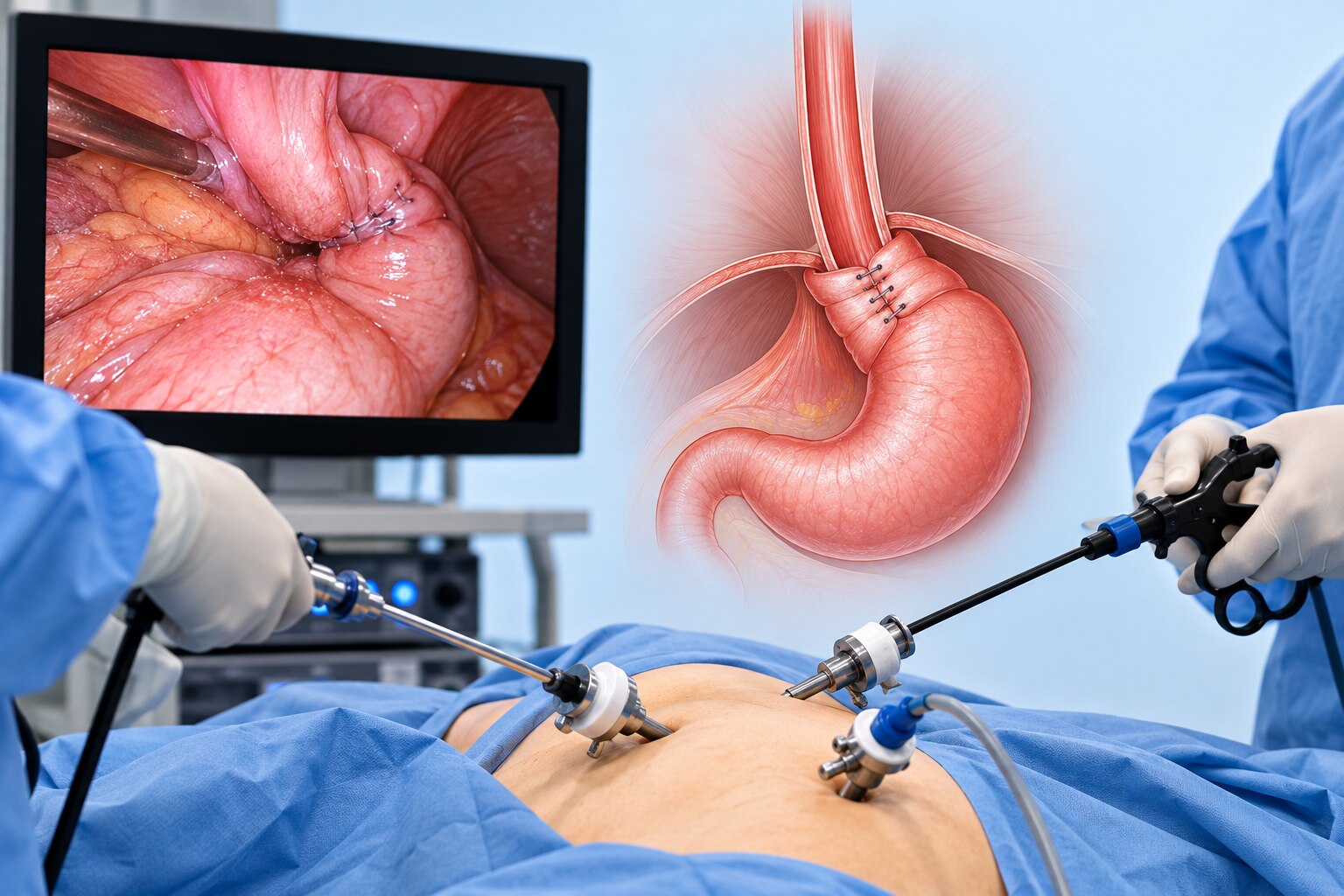
- Hiatal hernia size and anatomy: a sizeable or mechanically important hernia usually requires laparoscopic repair alongside the antireflux procedure.
- Oesophageal movement: manometry checks whether contractions push food normally and helps identify achalasia or weak motility, which can change the operation or rule it out.
- Medication response: persistent regurgitation despite correctly used proton-pump inhibitor treatment supports considering surgery only when testing confirms reflux. Symptoms that never improved and lack objective reflux evidence point toward another diagnosis.
- Patient factors: body habitus, previous upper-abdominal operations and the available surgical approach affect safety and expected benefit.
The surgeon should explain the trade-off, not present an operation as a permanent guarantee. Fundoplication can reduce acid reflux and regurgitation, yet cause difficulty swallowing, gas-bloat, or inability to belch or vomit; reflux or the hiatal hernia can recur.
Your preference to avoid long-term medication matters, but it must be weighed against these risks and the option of continuing medical treatment.
What plan should you leave the consultation with?
Leave with a written next-step plan, not an operation date. A GERD surgery consultation in Mumbai should state which diagnosis is being tested, which reports are missing, whether you continue or adjust medication, and which findings would make surgery reasonable.
Cough, hoarseness, throat clearing and atypical chest symptoms need objective reflux evidence before surgery is considered.
1. Confirm preparation: review every medicine, previous abdominal operation, smoking, weight and anaesthesia risks. Ask whether you need endoscopy, reflux monitoring or manometry before deciding. Correct PPI timing, weight reduction, earlier evening meals and head-of-bed elevation may come before an operation.
2. Confirm what surgery involves: general anaesthesia, laparoscopic access, possible hiatal-hernia repair, expected hospital stay and the rare possibility of conversion to open surgery. Ask how your diet will progress from liquids to normal textures, when you can drive and work, and which activity restrictions apply.
3. Confirm follow-up: ask when wounds, swallowing, reflux control and medication use will be reviewed, and what happens if symptoms recur. Further testing or treatment can still be necessary; surgery is not a guarantee that every throat or chest symptom will disappear.
A GERD treatment consultation in Mumbai becomes useful when the surgeon records these decisions and the reason behind each one. Dr Janhavi Kapadia can use that discussion to separate a suitable surgical pathway from continued medical treatment or further investigation, rather than treating a GERD diagnosis as an automatic booking.
Related service
Gastroesophageal Reflux Disease (GERD) Gastroesophageal Reflux Disease (GERD) Gastroesophageal Reflux Disease (GERD) is a chronic condition where stomach acid frequently flows back into the esophagus, causing irritation,... |
Frequently asked questions
What happens when you book and describe your symptoms?
The surgeon reviews your heartburn, regurgitation, chest or throat symptoms, timing, night-time episodes, triggers and response to medicines. This assessment does not commit you to surgery.
Which medicines and medical records should you bring?
Bring every current medicine with its dose and timing, including antacids and proton pump inhibitors, plus endoscopy reports, biopsy results, scans, blood tests and prior treatment notes.
Which tests can confirm reflux before surgery?
The surgeon may use upper endoscopy to inspect the oesophagus and stomach, ambulatory pH or impedance-pH monitoring to measure reflux, oesophageal manometry to assess movement and pressure, and a barium swallow when anatomy needs clarification.
How does the surgeon decide whether an operation is suitable?
The decision considers confirmed reflux, symptom severity, objective test results, response to medicines, anatomy, general health and your goals. The surgeon should also discuss continued medical treatment and its trade-offs.
What plan should you leave the consultation with?
Leave knowing the working diagnosis, tests still required, treatment options, preparation steps, follow-up date, expected recovery and symptoms that require prompt medical attention.
Keywords